Behaviour
Polycarpa papillata has control their body and body parts to respond to different conditions that it may experience (Rocha et.al2012).
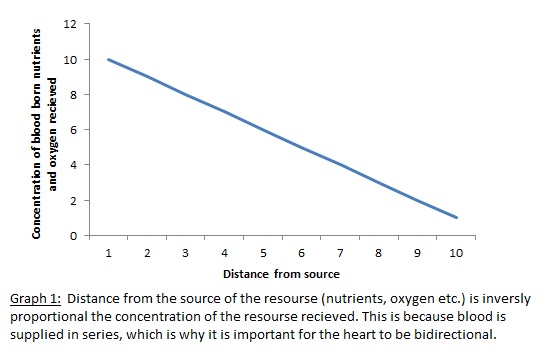
Like all tunicates P.papillata has a bidirectional heart which experiences heartbeat reversal every couple of minutes (Ruppert et.al 2004). The reversal of this heartbeat is fundamental to their survival as nutrient transfer is sequential with those organs closer to the source receiving high concentrations of nutrients and those further away receiving low concentration of nutrients (graph 1; Ruppert et.al 2004). The reversal of the heartbeat reverses this relationship that is, that those organs that were far from the source are now close and vice versa. This maintains transfer of nutrients at adequate levels to all organs without starving any (Ruppert et.al 2004).
P.papillata also has the ability to control the rate that water is flowing through its digestive and respiratory system (Ruppert et.al2004). The transfer of water is done by the lateral cilia that line the gill slits of the individual (Ruppert et.al 2004). By the control of these cilia individuals are able to increase or decrease the amount of water based pumped through the system based on respiratory or dietary needs.
When they are threatened or when their siphon is touched by something P.papillata has the ability to contract and change the shape of its body (Kott, 1985). In the lab this was induced by gently touching the incurrent siphon with a probe. P.papillata is able to do this because of its transverse and longitudinal body musculature which has the ability to completely change the shape of the body, not just close the siphon (Kott,1985). The complete change of body shape is due to the body wall being closely and strongly adhered to the test (Kott,1985).
Other behaviours that were observed in the lab involved the rejection of large particles. There were two different responses that were able to be induced by putting particles in the incurrent siphon that were too large to flow through the esophagus of the collected individuals. These were characterised into a “flicking” (vid. 1) and a “coughing” behaviour (vid. 2).
Video 1: Demonstration of the observed flicking behaviour
Video 2: Demonstration of the observed coughing behaviour
To investigate the anatomical feature that allowed for this behaviour a series of dissections were undertaken for the results see Anatomy and Physiology.
Reproduction is oviparous, spawning and only sexual in this species as they do not form colonies or bud asexually (Ruppert et.al 2004; Zeng et.al 2006; Sorte et.al 2010; Rocha et.al 2012). They are hermaphroditic but do not experience self-fertilisation, instead rely on proximity to others to successfully reproduce (Rocha et.al 2012). |